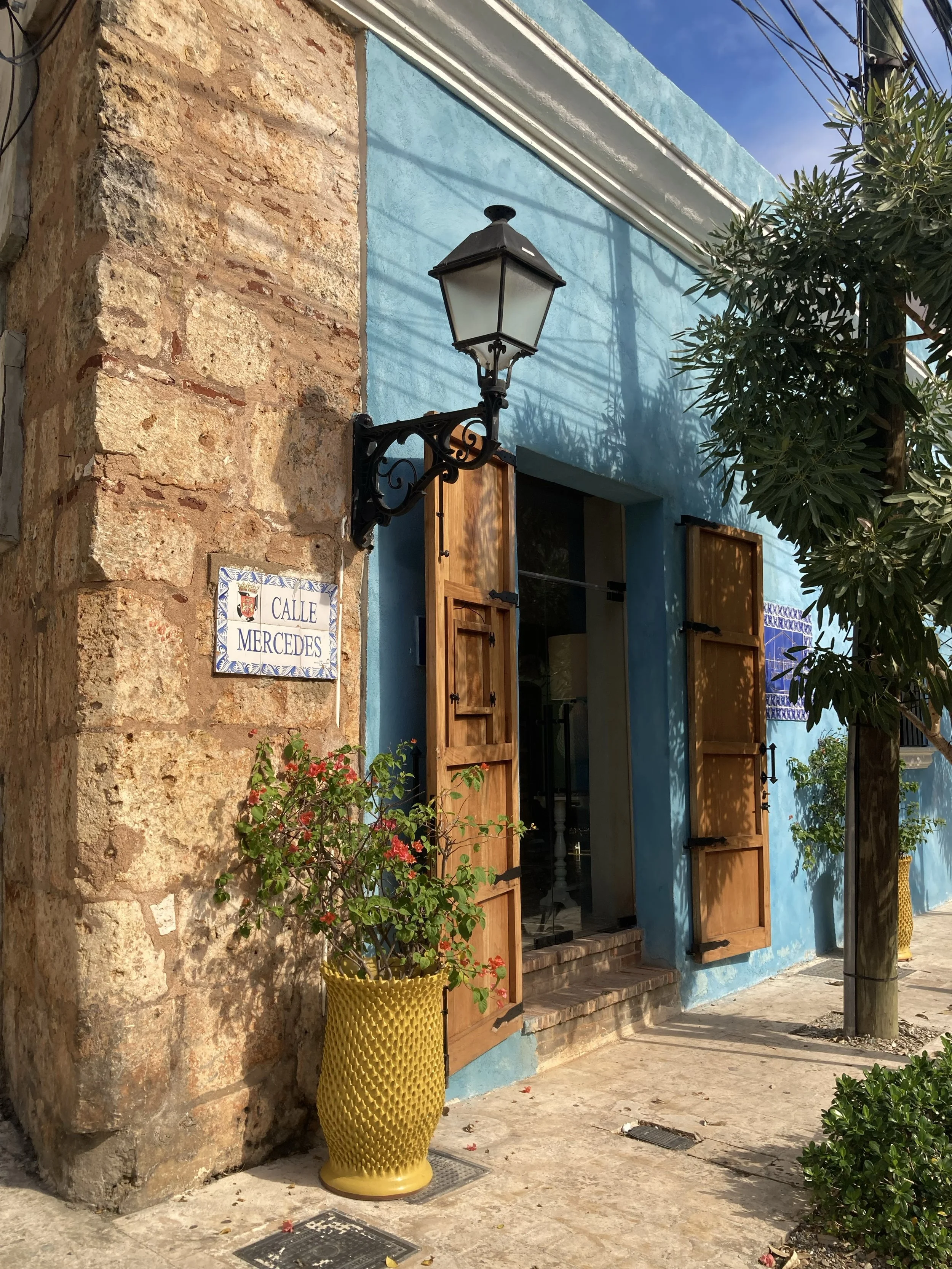
A street corner in the Zona Colonial, Santo Domingo
Culturismo now provides 30 Professional Development Points in history/social studies for Massachusetts teachers!
Join our 8-day trips to the Dominican Republic during April school vacation week!
Culturismo, a family-owned LLC, offers 15 high-quality PDPs in history/social studies at the middle- and high-school levels and 15 PDPs in strategies for teaching all students through an eight-day educational travel program in the Dominican Republic.
Led by Ph.D.s in history and sociology, the program engages with DOE curriculum topics in world geography and U.S. and world history through encounters with Taíno culture, the Columbian Exchange, Spain’s New World empire, sugar and slavery, the Haitian Revolution, and U.S. influence in the Caribbean.
Having completed a set of preparatory readings, teachers will experience customized tours of the New World’s first cathedral, hospital, fortress, convent and university, as well visiting one of the first slave-based sugar plantations in the Americas.
On the north coast we will visit caves containing Taíno pictographs and see traditional and modern cacao and coffee plantations. In both areas participants will visit public schools and interact with teachers, students and administrators.
Each cohort will work together to plan pedagogical strategies based on their firsthand experience of Dominican history and culture. Beyond curriculum content, our goal is to help teachers find culturally and linguistically responsive ways to teach all students, especially newcomers from Latin America.
The Culturismo Team
Culturismo tours are led by co-founders Lilian Bobea and Cyrus Veeser, both of whom are Dominican specialists who hold doctorates and have experience leading study abroad trips to the Caribbean.
Prof. Bobea was born and raised in Santo Domingo, Dominican Republic. She earned a bachelor’s degree in sociology from the Universidad Autónoma de Santo Domingo before winning a Fulbright fellowship to attend SUNY/Binghamton, where she earned an M.A. in historical sociology, later completing her doctorate in development studies at the University of Utrecht in the Netherlands, where her dissertation supervisor was Dirk Kruijt. Bobea has published extensively on police reform and civil-military relations in the Dominican Republic; from 2004 to 2007 she worked with the Dominican government to develop a democratic security plan for the national police.
Cyrus Veeser completed his B.A., M.A. and Ph.D. at Columbia University, where his dissertation on the Dominican Republic won the Bancroft Prize and was published by Columbia University Press. He is a professor of history at Bentley University, where he teaches Latin American and Caribbean history. Veeser has led study abroad trips for undergrads and graduate students to the Dominican Republic, Cuba, Ecuador, Greece and Vietnam. The CVs attached for Bobea and Veeser highlight their publications on the Dominican Republic.
Bobea and Veeser work together in Culturismo with their daughters, Gabriela Blanco Bobea, who holds a bachelor’s degree in education from Hampshire College, and Minerva Veeser-Bobea, who graduated from Mount Holyoke College with a major in education and psychology. Gabriela and Minerva are tasked with coordinating logistics and helping with translation; Lilian and Cyrus will handle all instruction that counts toward fulfilling the PD.
Alignment with Massachusetts Social Studies Curriculum Framework and Standards for Effective Teaching
Grade 6
World Geography and Ancient Civilizations I
….
Topic 5. Central America, the Caribbean Islands, and South America [6.T5]
….
[a.] Physical and political geography and indigenous populations of Central America and the Caribbean Islands [6.T5a]
1. On a physical map of the world, use cardinal directions, map scales, key/legend, and title to locate Central America, the Caribbean Sea. On a map of the region, identify important physical features of the region (e.g. Gulf of Mexico, Yucatan Peninsula, the Panama Canal).
2. Demonstrate knowledge of political geography by locating the current countries and major cities of Central America and the Caribbean Islands on a political map; use knowledge of maps to complement information gained from text about a country or region.
3. Explain how absolute and relative locations, climate, major physical characteristics and natural resources influenced settlement, population size, and the economies of regions and countries in Central America and the Caribbean Islands.
4. Describe the culture and way of life of the indigenous populations of the region (e.g., Carib [Antilles and South America], Taino [Cuba, Trinidad, Jamaica, Hispaniola, Puerto Rico], Lenca [Honduras], Miskito [Nicaragua], Huatares and Chorotegas [Costa Rica], Lokono, also known as Arawak [Trinidad and Tobago]).
….
High School
U.S. History 1
Topic 7. Progressivism and World War I [USI.T7]
Which should take priority, domestic issues or our status as an international power?
….
5. Analyze the causes and course of growing role of the United States in world affairs from the Civil War to World War I, researching and reporting on one of the following ideas, policies, or events, and, where appropriate, including maps, timelines, and other visual resources to clarify connections among nations and events,
a. the purchase of Alaska from Russia (1867)
b. the influence of the United States in Hawaii leading to annexation (1898)
c. the Spanish-American War (1898) and resulting changes in sovereignty for Cuba, Guam, Puerto Rico and the Philippines; the Philippine-American War (1899–1902)
d. U.S. expansion into Asia beginning in 1899 under the Open Door policy
e. Theodore Roosevelt’s Corollary to the Monroe Doctrine (1904) and his “big stick” diplomacy in the Caribbean
f. The Platt Amendment describing the role of the United States in Cuba (1901) and the subsequent occupation of Cuba (1903, 1906–1909)
g. the role of the United States in the building of the Panama Canal (1904–1914)
h. William Howard Taft’s foreign policy of Dollar Diplomacy
i. United States involvement in the Mexican Revolution (1910–1920)
j. American entry of the United States into World War I (1917)
High School
World History 1
Topic 5. Global exploration, conquest, colonization, c. 1492-1800 [WHI.T5]
….
3. Identify the major economic, political, demographic, and social effects of the European colonial period in the Americas and the Caribbean Islands, the so-called “Columbian Exchange” (the transmission of foodstuffs, plants, bacteria, animal species, etc., across the Atlantic for the first time and its environmental and agricultural implications); the impact of Christian missionaries on existing religious and social structures in the Americas, and the expansion of the trans-Atlantic slave trade.
High School
World History II
Topic I: Absolute power, political revolutions, and the growth of nation states, c. 1700–1900 [WHII.T1]
Supporting Question: What are the similarities and differences of political revolutions in this period? ….
5. Compare the causes, goals, and outcomes of the American Revolution (1776–1787), the French Revolution (1789-1799), and the Haitian Revolution (1791–1804), and analyze the short-term and long-term impact of these revolutions on world history.
….
7. Identify the major political, social, and economic developments of Central and South American and Mexican history in the 19th century and analyze how these developments were similar to or different from those in Europe during the same time period.
Clarification Statement: Students may use the following as examples to address this standard.
a. the wars for independence that led to the creation of Latin America’s modern nation-states, including the influence and ideas of Simón Bolívar, José de San Martin, and their connections to the Haitian, American, and French Revolutions
b. b. economic and social stratification the role of the Catholic Church the 19th century wars between Liberals and Conservatives over whether to maintain or destroy the legacies of Spanish colonialism
c. the Mexican-American War of 1846-1848 and Mexico’s resulting loss of half of its territory to the United States
d. the growing power of the United States and its economic and political impact on Central America and the Caribbean, especially in the period before the Spanish-American War of 1898
e. the persistence of slavery in Cuba, Puerto Rico, and Brazil until the end of the 19th century
Topic 3. The global effects of 19th century imperialism [WHII.T3]
Supporting Question: What factors led to European imperial ambitions?
….
3. Analyze the impact of Western imperialism in Asia, Africa, and Latin America.
Clarification Statement: In addressing Standard 18, students should gain an overall view of what modern imperialism was and be able to relate that to their knowledge of earlier empires from World History I.
Students may study in depth imperialism on one continent, choosing a former colony to research, and using maps, images, literature, and other primary and secondary sources to create a case study of the area before, during, and after the colonial period, explaining the process of decolonization, and evaluating the success of the independent nation.
….
Latin America
a. Spanish control of Cuba and Puerto Rico; Portuguese colonial rule in Brazil
b. the drive by the United States to annex Mexico’s northern territories, the Dominican Republic, Nicaragua, Cuba, and other Caribbean territories
c. the Spanish-American War of 1898
Integration with Standards for Effective Teaching
Our offering addresses the following key points in the SET:
· Standard I: Curriculum, Planning, and Assessment.
o IA Curriculum, Knowledge of Students. Our PD program helps teachers gain “knowledge of their students' identities, skills, developmental levels, cultures, languages, and communities.”
IB Assessment. Our experiential PD program will guide teachers in “creating opportunities for students to be able to draw from their cultural and linguistic knowledge and personal experiences” by giving them hands-on experience of one Latin American society.
o IC Analysis. Culturismo’s PD program will provide students with a new context to in which to “Collaborate with students and their families, in an accessible format and language.”
· Standard II: Teaching All Students.
IIA Instruction. Our program will prepare teachers to make their instruction engaging by exploring topics “in culturally and linguistically sustaining ways” that build on “students’ strengths, interests, [and] cultural and linguistic backgrounds.”
Our PD program will also help teachers make instruction more inclusive by giving them insights that encourage the “leveraging of students’ native language and linguistic resources.”
· Standard III: Family and Community Engagement.
IIIA Communication with Families. Exposure to Dominican culture will help teachers establish two-way communication with families that “is culturally and linguistically sustaining and aligned with family preferences, in language(s) that families understand.”
IIIB & C Engagement & Collaboration. Through their direct experience of Dominican culture, teachers will gain a better sense of ways to provide “a variety of frequent, inclusive and culturally and linguistically responsive opportunities for all families to engage as partners in the classroom community.” Such engagement will be facilitated by teachers’ new approaches to “leveraging families’ cultural and linguistic knowledge and expertise as assets.”